
Prelude
We use Okta as our identity tool. Humaans and HiBob are our HRIS and the actual source of truth. Organisationally our most atomic units are teams, groups of teams, and departments. Everything else is built on top.
The problem
Like many companies that get bigger and more complex, we ended up representing the org structure in a dozen places and none of them were quite right. Google Groups were kept up to date manually by whoever had the time, the patience, or got annoyed enough. Slack user groups existed, then drifted, and channel membership was basically “add people whenever you remember.”
Access was not tied to roles or automations in any consistent way. The worst part was not even the mess. It was the time lost to small manual tasks. New joiners would land and we would still be nudging them into the right places one by one. This is busywork masquerading as process.
The solution
Back in 2022 we did a fair bit of work with Humaans to tighten how provisioning behaved. The key was getting reliable HRIS data flowing into Okta as attributes, sometimes default and sometimes custom, so that the user profile actually reflected reality.
That immediately led to the real problem: how do we automatically create, update, and retire the groups that represent this structure inside Okta itself, and then push it to other tools?
Okta Workflows
The engine runs on top of Okta Workflows, a low-code automation tool similar to Zapier or Workato. It offers native connectors to different services, lets you create logic, and makes API calls easy with built-in authentication options like OAuth or bearer tokens.
A flow starts from a trigger, for example a user profile update, a scheduled run, or an inbound webhook, then moves through predefined actions.
Version 1
The first iteration was straightforward and a bit loud. We used
user profile updated in Okta Workflows as the trigger. Any time HRIS changed a
user’s profile, the flow would check:
- Is this a change we care about, for example the team field?
- Does
team-cucumberexist? - If not, create it.
- If it does, validate and exit.
- If the previous group is empty, archive it.
When creating, we also added a group rule so future membership stayed automatic. It worked, but it fired for every profile update, which meant noise and a lot of safeguards to avoid duplication and wasted compute.
We also set conventions so humans and automations could reason about things:
names like team-cucumber, and descriptions starting with AUTO orgType so you
know a group is managed. A structure was beginning to emerge.

Version 2
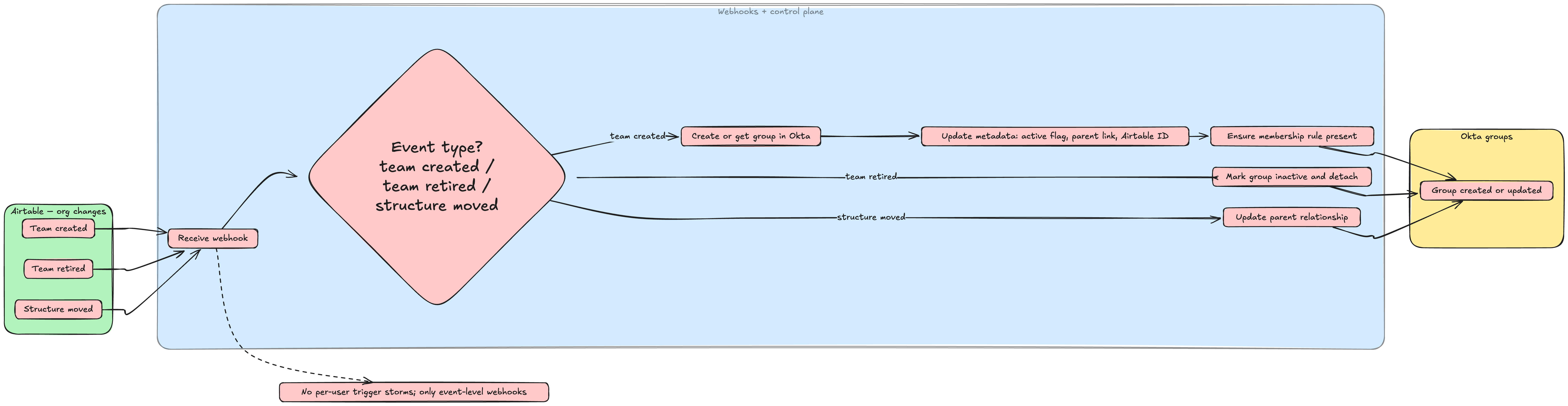
We moved to webhooks and a small control plane. On the HRIS side we already had Airtable, a hybrid database-spreadsheet tool we use as our self-serve orchestration layer for org changes, so we tied webhooks to the events that actually matter: team created, team retired, and structure moved.
Groups in Okta were populated with extra metadata so we could treat and query them like first-class objects rather than just names:
- an
activeflag - parent relationships for groups of teams
- the Airtable ID for fast reconciliation
We no longer had to worry about hundreds or thousands of triggers firing.
The rest
Once Okta had clean, lifecycle-aware groups, the downstream tools got much easier.
Google, Notion, and Slack were easy wins because SCIM and group push are available in the OIN apps where supported. Point the automation at anything matching the convention and it goes.
Slack has a wrinkle: if you are on Enterprise Grid, pushed groups land at the enterprise level, not the workspace, which means you need a bit of API work to attach them to channels. Not my favourite behaviour change, but it is stable now. This is exactly why conventions help. You can find and fix things consistently.
GitHub needed more hands-on work. You can map IdP groups to GitHub Teams, which is great, but you still have to create the team and link it via API. Worth doing.
Their API is genuinely pleasant, and once it is linked, drift stops being a
thing. This also unlocked more interesting use cases. Engineering leadership
asked for specialisations for PR reviews, for example a frontend reviewer pool.
We added a specialisation attribute in HRIS, let the automations create the
specialisation-frontend group, and pushed that into Google and GitHub.
Now any PR can target a group that updates itself, grabbing anyone who is available. Or a calendar invite can be sent to all frontenders in one click. Super, super nice.
The other lesson here is visibility. Automation is best when it is invisible, which unfortunately means people assume nothing is happening. I was personally guilty of under-documenting this in the past. We are fixing that with a new initiative in collaboration with our People Tech and Finance Systems friends: brand-new documentation and demos on what exists, what the names mean, and how a new attribute gets wired end-to-end.
The future
There is plenty more to do, and most of it becomes obvious once the foundations are solid.
Making things more visible would be the biggest win. Not everyone needs Okta admin access to see what a team or department has access to. Discord’s Access is a particularly interesting project in this space. I can imagine a Slack bot that messages someone when they change teams to explain what changed and why.
We are also hoping that all of these automation bonuses give us more leverage in tool procurement: does this expensive SaaS tool support Okta, and if yes, how well?
We are also trialling and slowly introducing OIG to enable self-serve access flows and better auditability.
Infra as code remains the North Star. Terraforming parts of the setup and adding the same kind of branch protection we expect from production code is another step toward being bulletproof and compliant.
The longer-term point is stability. Reorgs, renames, and new departments should not be dramatic. With stable IDs, metadata, and naming conventions, those become attribute updates the system can digest without fuss. The easy wins will always exist, but the real value is in removing the busywork people stopped noticing.
The more invisible this gets, the better it is.
Disclosure: I used AI to tighten up and format my sometimes rambling thoughts. Meme generated on imgflip.com. Diagrams created in Excalidraw.